165 Exam Questions for DP-600 Updated Versions With Test Engine [Q25-Q41]

Rate this post

165 Exam Questions for DP-600 Updated Versions With Test Engine

Pass DP-600 Exam with Updated DP-600 Exam Dumps PDF 2025

Microsoft DP-600 Exam Syllabus Topics:

Topic Details
Topic 1
  • Prepare data: This section of the exam measures the skills of engineers and covers essential data preparation tasks. It includes establishing data connections and discovering sources through tools like the OneLake data hub and the real-time hub. Candidates must demonstrate knowledge of selecting the appropriate storage type—lakehouse, warehouse, or eventhouse—depending on the use case. It also includes implementing OneLake integrations with Eventhouse and semantic models. The transformation part involves creating views, stored procedures, and functions, as well as enriching, merging, denormalizing, and aggregating data. Engineers are also expected to handle data quality issues like duplicates, missing values, and nulls, along with converting data types and filtering. Furthermore, querying and analyzing data using tools like SQL, KQL, and the Visual Query Editor is tested in this domain.
Topic 2
  • Maintain a data analytics solution: This section of the exam measures the skills of administrators and covers tasks related to enforcing security and managing the Power BI environment. It involves setting up access controls at both workspace and item levels, ensuring appropriate permissions for users and groups. Row-level, column-level, object-level, and file-level access controls are also included, alongside the application of sensitivity labels to classify data securely. This section also tests the ability to endorse Power BI items for organizational use and oversee the complete development lifecycle of analytics assets by configuring version control, managing Power BI Desktop projects, setting up deployment pipelines, assessing downstream impacts from various data assets, and handling semantic model deployments using XMLA endpoint. Reusable asset management is also a part of this domain.
Topic 3
  • Implement and manage semantic models: This section of the exam measures the skills of architects and focuses on designing and optimizing semantic models to support enterprise-scale analytics. It evaluates understanding of storage modes and implementing star schemas and complex relationships, such as bridge tables and many-to-many joins. Architects must write DAX-based calculations using variables, iterators, and filtering techniques. The use of calculation groups, dynamic format strings, and field parameters is included. The section also includes configuring large semantic models and designing composite models. For optimization, candidates are expected to improve report visual and DAX performance, configure Direct Lake behaviors, and implement incremental refresh strategies effectively.


NO.25 You are the administrator of a Fabric workspace that contains a lakehouse named Lakehouse1.
Lakehouse1 contains the following tables:
Table1: A Delta table created by using a shortcut
Table2: An external table created by using Spark
Table3: A managed table
You plan to connect to Lakehouse1 by using its SQL endpoint.
What will you be able to do after connecting to Lakehouse1?


NO.26 You need to design a semantic model for the customer satisfaction report.
Which data source authentication method and mode should you use? To answer, select the appropriate options in the answer area.
NOTE: Each correct selection is worth one point.

NO.27 You have a Microsoft Power B1 report and a semantic model that uses Direct Lake mode. From Power Si Desktop, you open Performance analyzer as shown in the following exhibit.

Use the drop-down menus to select the answer choice that completes each statement based on the information presented in the graphic. NOTE: Each correct selection is worth one point.

NO.28 You have a Fabric warehouse that contains a table named Staging.Sales. Staging.Sales contains the following columns.

You need to write a T-SQL query that will return data for the year 2023 that displays ProductID and ProductName arxl has a summarized Amount that is higher than 10,000. Which query should you use?


NO.29 You have a Fabric tenant that contains 30 CSV files in OneLake. The files are updated daily.
You create a Microsoft Power Bl semantic model named Modell that uses the CSV files as a data source. You configure incremental refresh for Model 1 and publish the model to a Premium capacity in the Fabric tenant.
When you initiate a refresh of Model1, the refresh fails after running out of resources.
What is a possible cause of the failure?


NO.30 You have a Fabric warehouse that contains a table named SalesOrderDetail. SalesOrderDetail contains three columns named OrderQty, ProductID and SalesOrderlD. SalesOrderDetail contains one row per combination of SalesOrderlD and ProductID.
You need to calculate the proportion of the total quantity of each sales order represented by each product within the sales order.
Which T-SQL statement should you run?


NO.31 You have a Fabric tenant that contains a workspace named Workspace1 and a user named DBUser.
Workspace1 contains a lakehouse named Lakehousel. DBUser does NOT have access to the tenant.
You grant DBUser access to Lakehouse1 as shown in the following exhibit.

Use the drop-down menus to select the answer choice that completes each statement based on the information presented in the graphic.
NOTE: Each correct selection is worth one point.

NO.32 You have a Fabric workspace that contains a Microsoft Power BI report named Report1. Your organization does not currently have an enterprise data warehouse. You need to leverage dataflows to bring data into a Power BI semantic model. You notice that access to one of the data sources is restricted to narrow time windows.
What should you do?


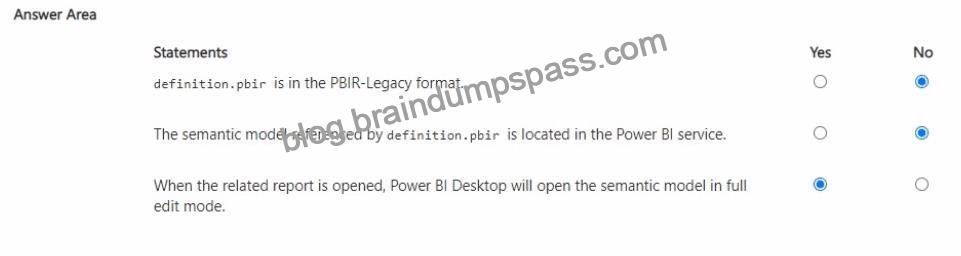
NO.33 You have a Microsoft Power Bl project that contains a file named definition.pbir. definition.pbir contains the following JSON.
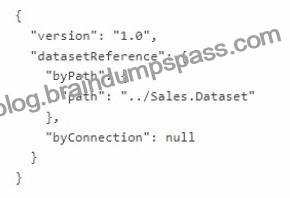
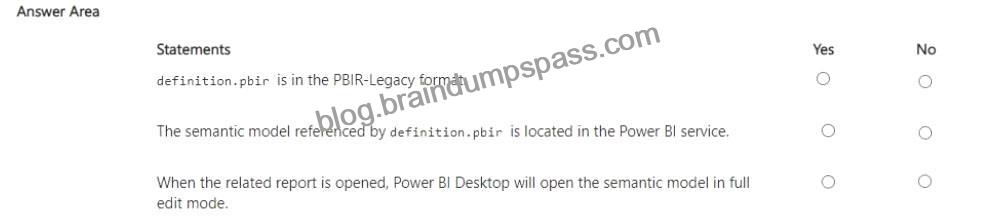
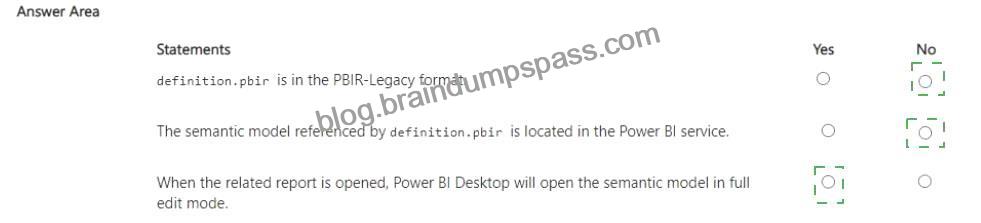
For each of the following statements, select Yes if the statement is true. Otherwise, select No. NOTE: Each correct selection is worth one point.
NO.34 You have a Fabric tenant that contains a semantic model named Model1. Model1 uses Import mode. Model1 contains a table named Orders. Orders has 100 million rows and the following fields.

You need to reduce the memory used by Model! and the time it takes to refresh the model. Which two actions should you perform? Each correct answer presents part of the solution. NOTE: Each correct answer is worth one point.


NO.35 You have a Fabric tenant named Tenant! that contains a lakehouse named Lakehouse1.
You need to add data to Lakehouse1 from a CSV file in an Azure Storage account outside of Fabric. The solution must minimize development effort.
What should you use to add the data?


NO.36 You have a Fabric workspace that contains a complex semantic model for a Microsoft Power BI report. You need to optimize the semantic model for analytical queries and use denormalization to reduce the model complexity and the number of joins between tables.
Which tables should you denormalize?


NO.37 Hotspot Question
You have a KQL database that contains a table named Readings.
You need to query Readings and return the results shown in the following table.

How should you complete the query? To answer, select the appropriate options in the answer area.
NOTE: Each correct selection is worth one point.

NO.38 You have an Azure Data Lake Storage Gen2 account named storage! that contains a Parquet file named sales.
parquet.
You have a Fabric tenant that contains a workspace named Workspace1.
Using a notebook in Workspace1, you need to load the content of the file to the default lakehouse. The solution must ensure that the content will display automatically as a table named Sales in Lakehouse explorer.
How should you complete the code? To answer, select the appropriate options in the answer area.
NOTE: Each correct selection is worth one point.

NO.39 Hotspot Question
You have a Fabric warehouse that contains a table named Sales.Products. Sales.Products contains the following columns.

You need to write a T-SQL query that will return the following columns.

How should you complete the code? To answer, select the appropriate options in the answer area.
NOTE: Each correct answer is worth one point.

NO.40 You are analyzing customer purchases in a Fabric notebook by using PySpanc You have the following DataFrames:

You need to join the DataFrames on the customer_id column. The solution must minimize data shuffling. You write the following code.

Which code should you run to populate the results DataFrame?


NO.41 You need to migrate the Research division data for Productline2. The solution must meet the data preparation requirements. How should you complete the code? To answer, select the appropriate options in the answer area NOTE: Each correct selection is worth one point.


DP-600 Exam Dumps – Free Demo & 365 Day Updates: https://www.braindumpspass.com/Microsoft/DP-600-practice-exam-dumps.html

Related Links: disqus.com myportal.utt.edu.tt www.stes.tyc.edu.tw www.stes.tyc.edu.tw myportal.utt.edu.tt www.stes.tyc.edu.tw

More Posts

Recent Comments
    Categories

    Post: 165 Exam Questions for DP-600 Updated Versions With Test Engine [Q25-Q41]

    Leave a Reply

    Your email address will not be published. Required fields are marked *

    Enter the text from the image below